
The Mountain Model™
of Collaborative Communication and Conflict Transformation
Every conversation begins from different perspectives. The Mountain Model is a framework for how to create shared understanding, reveal possibilities, and generate robust solutions while building respect and understanding for uniqueness among participants.
The model consists of 2 interrelated steps
1. Create Visibility.
2. Build from shared ground.

Developed by Erica Marx

When visibility is low, it can feel like you are talking across a gap
The work of the conversation is to lower the visibility line. As the line drops, more of each person's mountain becomes visible. Differences become easier to understand. The shared landscape below grows.
Lowering the line doesn't only reveal what you share. It also reveals where you differ, different priorities, different pressures, different things each of you is accountable for. The goal isn't to erase those differences. It's to name them clearly enough that both people feel seen and understood, even in what they don't agree on.
.png)
The mountains don't move. What changes is how much of each one you can see. Without that visibility, you're each standing on your own peak, talking across a gap instead of toward each other.
As visibility increases, move to building.
Building means making an offer, one at a time. Try something. Watch how it lands. What comes back, agreement, hesitation, or a new idea, becomes more of what you both now know is true. If an offer meets silence, or the same objection keeps coming back, that's the signal to return to visibility rather than push the offer harder.
Model in 2 Steps
1. CREATE VISIBILITY
2. BUILD TOGETHER
SELF
What's true for me that they can't see?
SHARED
What's true for both of us that neither has named?
OTHER
What's true for them that I haven't learned yet?
BUILD
Given what we can see, what becomes possible?
IF PROGRESS STALLS
Return to creating visibility
).png)
Stress Responses
Most people have conversational defaults, especially under stress. Most common is to continue explaining your thoughts, ideas, and logic, long after that is conversationally useful. Another common pattern is to default to focusing on the other person's desires at the expense of sharing your own perspective (hello conflict avoiders!). Its easy for groups to get stuck in revealing the issues and not taking action OR jump to building before enough is actually visible to create robust solutions.
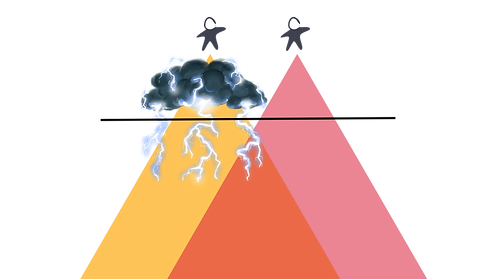
Stress, urgency, and fear can disrupt the weather of your conversation and limit what's possible. When one or both people become upset or overwhelmed, it is like a storm on the mountain. You can't thorough the clouds, and the swirling winds and lightening can feel threatening! If one person is triggered, either focus on acknowledging what they're saying to bring visibility back (and calm the storm) or take a break until the skies clear.
Create the conditions for the best conversation in advance and look at the weather report! If possible, plan conversations on days when visibility is likely to be good for both parties.
What Shapes the Landscape
)_edited.jpg)
The landscape isn't level between people. Authority, risk exposure, access to information, and freedom to speak differ from one mountain to the next. A staff member and their director aren't standing at the same height, and revealing more of the landscape doesn't erase that.
Naming the dynamic is part of the work. Where someone sits in the structure changes what they can safely reveal, what they need acknowledged before they'll reveal it, and how much weight their words carry once they do.
Visibility is also affected at a personal level, not just a structural one. Bias, preconceived notions, and emotional reactivity can obscure the landscape just as much as a difference in authority or access.
Application
Influence • Collaboration • Conflict Management
Use the model to prepare for a conversation where you need someone to see what you see, without having authority to make them act.
Use it to align a team or cross-functional group around what's actually shared, before jumping to a plan.
Use it to work through a stalled disagreement by returning to visibility instead of pushing toward resolution.
Even when visibility is possible, people often skip it. They move to solve, persuade, or brainstorm before the landscape is visible.
The Mountain Model slows that rush long enough to reveal what's actually shaping the conversation. That visibility creates room for clarity, inclusion, and durable next steps.

Developed by
Erica Marx
Erica Marx developed the Mountain Model out of more than fifteen years of work in mediation, coaching, facilitation, and applied improvisation, layered on top of each other in the order Erica encountered them.
Mediation is the starting point. Its foundational move is going from positions to underlying interests, and the model starts there too.
Transformative mediation shaped how the model works with that move. It trusts people to make the shift themselves rather than pushing them toward it, and it supports the conversation instead of directing it.
Coaching shaped the questions the model uses, the ones that open up possibility once enough of the landscape is visible. Improvisation shaped how the model builds, one offer at a time, and gave it the capacity to hold more than one truth at once instead of treating one person's truth as canceling out another's.
Trauma informed practice shaped the model's understanding of dysregulation, how it limits what a person can see or say no matter how much visibility work has happened. Facilitation and leadership coaching shaped its last layer, attention to the systemic forces that shape how people and groups see each other in the first place.
This model's distinct contribution is the visibility line itself, and the discipline of keeping Self, Other, and Shared Landscape as acts of revealing, separate from Build, which only follows once that revealing has happened.